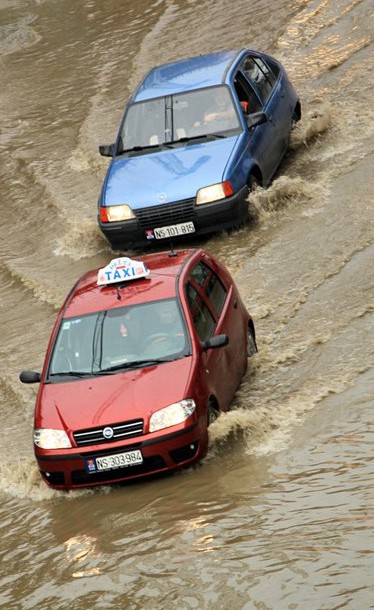
Sometimes the best vocabulary lessons arrive unannounced - in a text message from a friend, in a news headline, or, as happened this week, in a set of photographs that arrived in my inbox and made my eyes go wide. My friend Gale lives in Novi Sad, and after a dramatic spring storm swept through the city, she very kindly sent me some of the photos she had taken of the streets outside her window.
They are striking images, and they immediately made me think: this is exactly the kind of real, vivid scene that is perfect for practising vocabulary and photo description in Serbian. So today, thanks to Gale's generosity, we are going to look at the aftermath of an oluja - a storm - and learn to describe what we see.
What is this about?
This post shares photos taken by my friend Gale in Novi Sad after a spring storm, and uses them as the basis for a vocabulary and picture-description exercise in Serbian. Describing photographs is a wonderfully practical skill: it comes up in everyday conversation, in travel situations, and even in language exams. More than that, it forces you to reach for real vocabulary - the kind that lives in the world rather than just on a word list.
A huge thank you to Gale for sharing these and giving us all something so vivid to work with. Novi Sad is a beautiful city at the best of times, and even a storm cannot take that away - though it certainly rearranges the furniture, as you will see.
Take a moment to look at the image below before you read on. What do you notice? What words come to mind? Hold those thoughts - we are about to meet the Serbian for all of them.
The vocabulary
Here are the key words you will need for this exercise. Take a few minutes to read through the table, say each word aloud, and then close the page and see how many you can recall. Do not worry about getting them all on the first pass - that is perfectly normal.
| Serbian (Latin) | English |
|---|---|
| oluja | storm |
| kiša | rain |
| grad | hail |
| poplava | flood |
| automobil | car |
| taksi | taxi |
A small note worth remembering: grad in Serbian has two meanings. As a weather term it means hail - those small, hard pellets of ice that batter car roofs and flatten gardens. As an everyday noun it means city or town. Context always makes it clear which one is meant, but it is a good example of how Serbian rewards careful listening.
The task
Now for the fun part. Look back at the photo - really look at it - and try to answer these two questions in Serbian. Write your answers in the comments below; I read every single one and will give you feedback. There are no wrong attempts, only brave ones.
-
Šta vidiš na slici?
What do you see in the picture?
Describe as many things as you can. Even a single sentence is a victory: Vidim automobile (I see cars) is a perfectly good start. Vidim poplavljen put (I see a flooded road) is even better. -
Kakvo je vreme?
What is the weather like?
Use the vocabulary from the table above. You might try: Vreme je lose (The weather is bad), or Bila je velika oluja (There was a big storm), or Pada kiša (It is raining / Rain is falling).
Aim to write at least two or three sentences for each question. Push yourself a little further than feels comfortable - that is exactly where the learning is hiding.
How to describe a photo in Serbian
Describing a photo well in any language is really about having a mental checklist: start with what dominates the frame (the big shapes, the main action), then move to details (colours, objects in the background, anything unusual), and finish with an impression or a feeling if you can manage it. In Serbian, the structures you reach for first will be vidim (I see), na slici je (in the picture there is), and izgleda kao (it looks like) - these three will take you a very long way.
Do not be afraid to guess or approximate: if you do not know the exact word for a waterlogged gutter, voda na putu (water on the road) is honest and clear Serbian, and any native speaker will understand you perfectly. Aim for communication first, precision second. The precision will come with time.
Frequently asked questions about this exercise
What city is Novi Sad in Serbia?
Novi Sad is the capital of the northern Serbian province of Vojvodina and the second-largest city in Serbia after Belgrade. It sits on the banks of the Danube and is famous for its beautiful fortress (Petrovaradin), its lively cultural scene, and the EXIT music festival. It is a city well worth knowing about - and well worth visiting.
Is "grad" really the same word for "city" and "hail"?
Yes, it is. The two words are historically unrelated but have arrived at the same form in modern Serbian. Grad meaning city comes from a Slavic root connected to "enclosure" or "fortified place" (compare: Beograd, Novi Sad, Leningrad). Grad meaning hail is a weather term. Native speakers never confuse them because the context is always clear.
How do I say "it was raining heavily"?
The most natural way is Jako je padala kiša (Rain was falling heavily) or Lilo je kao iz kabla (It was pouring as if from a bucket) - a very common Serbian expression for heavy rain that literally translates as "it was pouring as from a barrel/cable." Colourful and very useful.
Can I use "auto" instead of "automobil"?
Absolutely - auto is the everyday spoken form and sounds completely natural. Automobil is the full form, slightly more formal or written. You will hear both in daily conversation.
Where can I find more picture-description practice?
The best practice is to find a photo you like - from the news, from your own camera roll, from a postcard - and write five sentences about it in Serbian. Then come back here and post it in the comments. Real photos, real practice, real feedback.
Thank you again to Gale for these wonderful photos. I love it when the blog is fed by real life in this way - it keeps the Serbian grounded and true and connected to the actual world where the language lives. I hope the storm has passed now, Gale, and that the sun is back over Novi Sad!
And to everyone who takes the time to write something in the comments: you make this the most cheerful corner of the internet, and I am grateful for every word.
- Marina Petrovic
Want to build more everyday Serbian word power? More everyday Serbian is just a click away.